

Technical Indicators
Pivot Points
Pivot Points are mainly used by "day traders" to predict the direction of short-term price evolution, as well as session resistances and supports based on the highs and lows of a previous period of time. The advantage of this method is that it is simple to use and provides very interesting results.
This method is particularly used by traders in the forex, commodities, or indices markets, where liquidity is high.
There are several methods for calculating pivot points available in Axial Finance (parameter Type):
- Standard Pivot Points
- Fibonacci Pivot Points
- Camarilla Pivot Points
- Woodie's Pivot Points
- DeMark's Pivot Points
The previous time period used for the pivot point calculation, called "Time Frame", is to be chosen based on the considered short-term horizon. The following "Time Frames" are available in Axial Finance (parameter Period).
- 1 Hr
- 2 Hrs
- 4 Hrs
- Daily
- Weekly
- Monthly
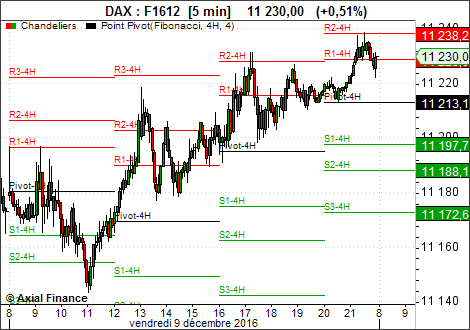
Example 1
The DAX futures contract with Fibonacci Pivot Points in a 4 Hrs Time Frame over an entire session
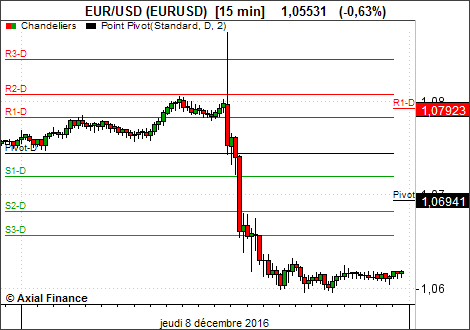
Example 2
The EURUSD pair with Standard Pivot Points in a Daily Time Frame during a 24-hour day
Interpretation
The pivot price P is the main resistance/support level. This means that the most significant price fluctuations are expected at this level. The other levels R1, R2, R3, S1, S2 and S3 have less influence but can trigger significant movements.
Pivot points can be used in two ways:
- for determining the general market trend: if a pivot price is broken to the upside, the market is bullish (and vice versa).
- to open and close positions.
Note: Do not forget, however, that pivot points are short-term indicators valid only for the current day.
Calculation Method
- C = Closing price of the previous Time Frame
- H = High price of the previous Time Frame
- L = Low price of the previous Time Frame
- O = Opening price of the previous Time Frame
- Standard Pivot Points:
                Resistance R3 = H + 2*(Pivot - L)

Resistance R2 = Pivot + (H - L)

Resistance R1 = 2*Pivot - L

Pivot = (H + L + C)/3

Support S1 = 2*Pivot - H

Support S2 = Pivot - (H - L)

Support S3 = L - 2*(H - Pivot) - Fibonacci Pivot Points:
                Resistance R3 = Pivot + (H - L)

Resistance R2 = Pivot + 0.618*(H - L)

Resistance R1 = Pivot + 0.382*(H - L)

Pivot = (H + L + C)/3

Support S1 = Pivot - 0.382*(H - L)

Support S2 = Pivot - 0.618*(H - L)

Support S3 = Pivot - (H - L) - Camarilla Pivot Points:
                Resistance R3 = C + (H - L)*1.1/4

Resistance R2 = C + (H - L)*1.1/6

Resistance R1 = C + (H - L)*1.1/12

Pivot = (H + L + C) / 3

Support S1 = C - (H - L)*1.1/12

Support S2 = C - (H - L)*1.1/6

Support S3 = C - (H - L)*1.1/4 - Woodie's Pivot Points:
                Resistance R2 = Pivot + (H - L)

Resistance R1 = 2*Pivot - L

Pivot = (H + L + 2*C)/4

Support S1 = 2*Pivot - H

Support S2 = Pivot - (H - L) - DeMark's Pivot Points:
            If C < O then x = H + 2*L + C

If C > O then x = 2*H + L + C

If C = 0 then x = H + L + 2*C


Pivot = x/4

Resistance R1 = x/2 - L

Support S1 = x/2 - H