

Technical Indicators
Moving Average Convergence Divergence
The Moving Average Convergence Divergence, or MACD, was developed by Gerald Appel and is presented in his book The Moving Average Convergence Divergence Trading Method.
The MACD is essentially an improvement on the two moving average system:
- First, it measures the price difference between two Exponential Moving Averages of different periods. A period of 12 days for the first moving average and 26 days for the second is commonly used. This difference, measuring the rate of price change, is referred to as MACD(12,26).
- Next, a third Exponential Moving Average of a slightly shorter period (generally 9 days) called the "signal line" or "trigger" is associated with it, which averages the MACD(12,26).
- Finally, the difference between the MACD(12,26) and the "trigger" is calculated, a difference measuring
the acceleration of price variation.
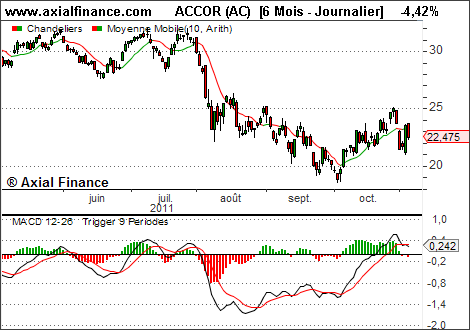
This acceleration is graphically represented as a histogram (MACD histogram).
The indicator is primarily used for trending markets and should not be used for consolidating or non-trending markets.
The use of exponential moving averages allows for greater sensitivity to recent changes.
Example
Interpretation
When the MACD histogram crosses above the zero axis, a buy signal is generated. Conversely, when the MACD histogram crosses below the zero axis, a sell signal is generated.