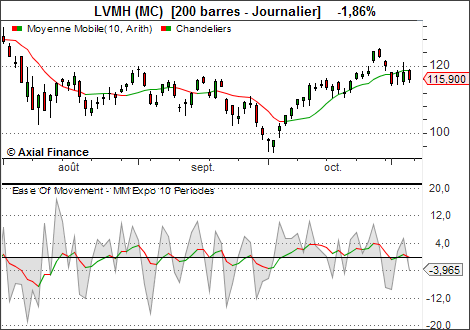
The Ease of Movement (or EMV) indicator, developed by Richard W Arms Jr., determines the ease or difficulty
with which the market can move (up or down).
The indicator evaluates the volume required to change prices: the greater the price variation and the lower the volume,
the "easier" the price movement is considered to be.
High positive values of this indicator occur when prices are rising on low volume, and strong negative values occur when
prices are falling on low volume.
If prices do not change, or if high volumes are associated with price changes, then the indicator will remain near zero.
The Ease of Movement indicator produces a buy signal when its Moving Average
crosses above the zero line, and conversely, a sell signal when it crosses below the zero axis.